Tom, Senior Project Manager at Blue Pangolin Consulting, has contributed to a major new global study published in Nature Communications that provides the most comprehensive assessment to date of the Third Global Coral Bleaching Event (2014 to 2017). Drawing on thousands of reef surveys and satellite heat stress data, the research quantifies the scale of bleaching and mortality worldwide and underscores the accelerating impacts of ocean warming on coral reef ecosystems.
Blue Pangolin Consulting is pleased to share that Tom Dallison is among the many international co-authors of a major new scientific publication analysing the impacts of the Third Global Coral Bleaching Event. Published in Nature Communications, the open access article, “Severe and widespread coral reef damage during the 2014–2017 Global Coral Bleaching Event”, provides the most comprehensive global assessment to date of the scale and severity of bleaching and coral mortality during this unprecedented three year marine heatwave
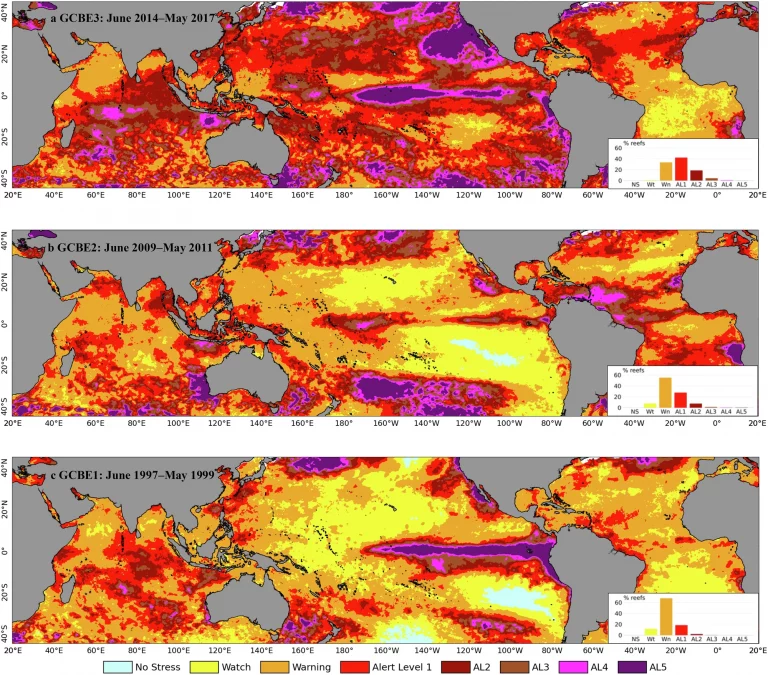
Global pattern of maximum heat stress from a The Third Global Coral Bleaching Event (GCBE3) 2014–17, b GCBE2 2009–2011, and c GCBE1 1997–1999. Heat stress categories of Alert Levels 1 and 2 correspond to moderate reef-wide coral bleaching (4 ≤ DHW < 8 °C-weeks) and severe reef-wide bleaching with moderate mortality (8 ≤ DHW < 12 °C-weeks), respectively. Newly established Alert Levels 3–5 correspond to the risk of increasingly severe mortality of corals across reefs. Inset histograms show the percentage of reef-containing pixels reaching each heat stress level during each global coral bleaching event. See: Eakin, C.M., Heron, S.F., & Connolly, S.R. et al. (2026)
The study synthesised data from 15,066 reef surveys conducted worldwide between 2014 and 2017. It found that 80% of surveyed reefs experienced moderate or greater bleaching, while 35% reported moderate or greater mortality. By combining in water observations with satellite derived heat stress data, the authors estimated that more than half of the world’s coral reefs suffered significant bleaching during the event, with 15% experiencing substantial mortality.
At the time, the 2014 to 2017 event was the most severe global bleaching episode on record, surpassing previous events in 1998 and 2010. It also marked the first global bleaching event to extend well beyond a single year. The publication demonstrates that ocean warming is accelerating the frequency, extent and severity of coral reef heat stress, with serious implications for reef ecosystems and the communities that depend on them.
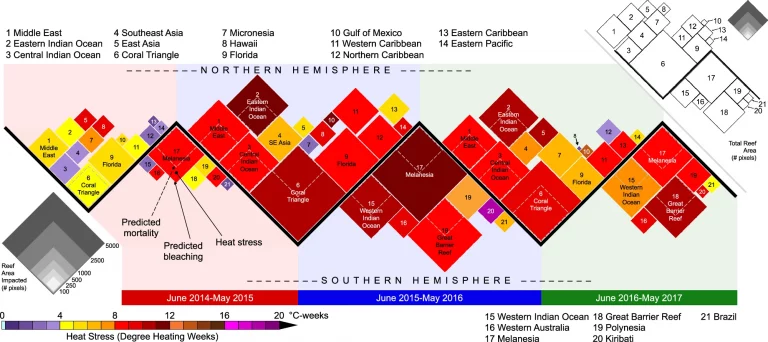
Model-predicted extent of reefs impacted by moderate or greater (>10% of corals) bleaching (solid diamonds) and moderate or greater mortality (sub-diamonds, outlined in white inside the larger diamonds) for the 21 GCBE3 regions, in units of number of ~5 × 5 km2 satellite pixels (scale at left). The central solid-black line denotes the Equator through annual cycles. Colors represent the maximum heat stress in each region in that bleaching year (DHW in units of °C-weeks, scale at lower-left); to improve legibility, white text was used in diamonds for heat stress below 2 °C-weeks and above 9 °C-weeks; black text was used for 2–9 °C-weeks. The inset (top-right) indicates the total reef area for each GCBE3 region. See: Eakin, C.M., Heron, S.F., & Connolly, S.R. et al. (2026).
Tom contributed as one of a large, collaborative authorship team spanning more than 100 scientists and institutions worldwide. His involvement in this publication directly complements his role as an editor of the forthcoming Status of Coral Reefs of the World: 2025 report, produced by the Global Coral Reef Monitoring Network, including recent regional assessments in the Caribbean and the Pacific.
The new study provides critical scientific context on the scale and severity of the 2014 to 2017 bleaching event, helping to strengthen the evidence base that underpins global coral reef reporting. This interlinkage between peer reviewed global analyses, driving global coral reef policy, and coordinating initiatives reinforces Blue Pangolin Consulting’s role at the intersection of science and policy for the world’s coral reefs.
By contributing both to foundational research and to the next global status assessment, Blue Pangolin continues to play an active part in shaping how coral reef trends are understood, communicated and translated into policy relevant knowledge at the international, regional and national levels.
The publication underscores the importance of coordinated global datasets, long term monitoring networks, and the integration of satellite and field observations. As the Fourth Global Coral Bleaching Event continues to unfold, the findings provide critical context for understanding both the scale of recent impacts and the urgency of climate action.
The full article is available open access via Nature Communications: https://doi.org/10.1038/s41467-025-67506-w
Full citation: Eakin, C.M., Heron, S.F., Connolly, S.R. et al. Severe and widespread coral reef damage during the 2014-2017 Global Coral Bleaching Event. Nat Commun 17, 1318 (2026). https://doi.org/10.1038/s41467-025-67506-w